Trade Talk
Digital Presence
Is Not Marketing
It is the infrastructure behind how modern customers find, check and choose a business.
There is a phrase we hear surprisingly often from established trade businesses:
“We don’t really do marketing. Most of our work comes through word of mouth.”
And that may be completely true. But word of mouth no longer ends with the recommendation. It starts the search.
Someone mentions your name in a kitchen, at the school gate or in a WhatsApp group. The person listening takes out their phone. They search for your business, open your Google profile, scan your reviews, look for a website and flick through photographs. They may check Facebook, Instagram, a trade directory or an accreditation body. Increasingly, they may ask an AI tool who appears credible, experienced and suitable for the work.
The recommendation got your name into the conversation. Your digital presence decides whether confidence follows.
That is why digital presence and marketing are not the same thing. Marketing includes advertising, campaigns, content, promotions, email, social media and lead generation. It is deliberately used to attract interest and create enquiries.
Your digital presence is the wider picture people find when they look for you. It includes your website, Google Business Profile, reviews, photographs, social profiles, directory listings, accreditations, contact details, project evidence, local mentions, the things you publish and the things other people say about you.
It exists whether you actively market the business or not. Whether it is strong, weak, complete, neglected or contradictory, it is already influencing decisions.
Marketing is something you do.
Your digital presence is something you have.
The customer does not see separate platforms.
Businesses tend to think in channels. The website is one job. Google is another. Reviews sit somewhere else. Instagram belongs to somebody in the office. A directory profile was created years ago and has not been touched since.
The customer does not see any of that separation. They see one business.
One search might begin on Google, move to your website, continue through your reviews and finish on Instagram. Another might begin with a recommendation, pass through Facebook and end with a phone call. An AI generated answer may introduce your name, but the customer may still look for independent evidence before making contact.
No single platform has to do every job. Together, they have to tell one convincing story.
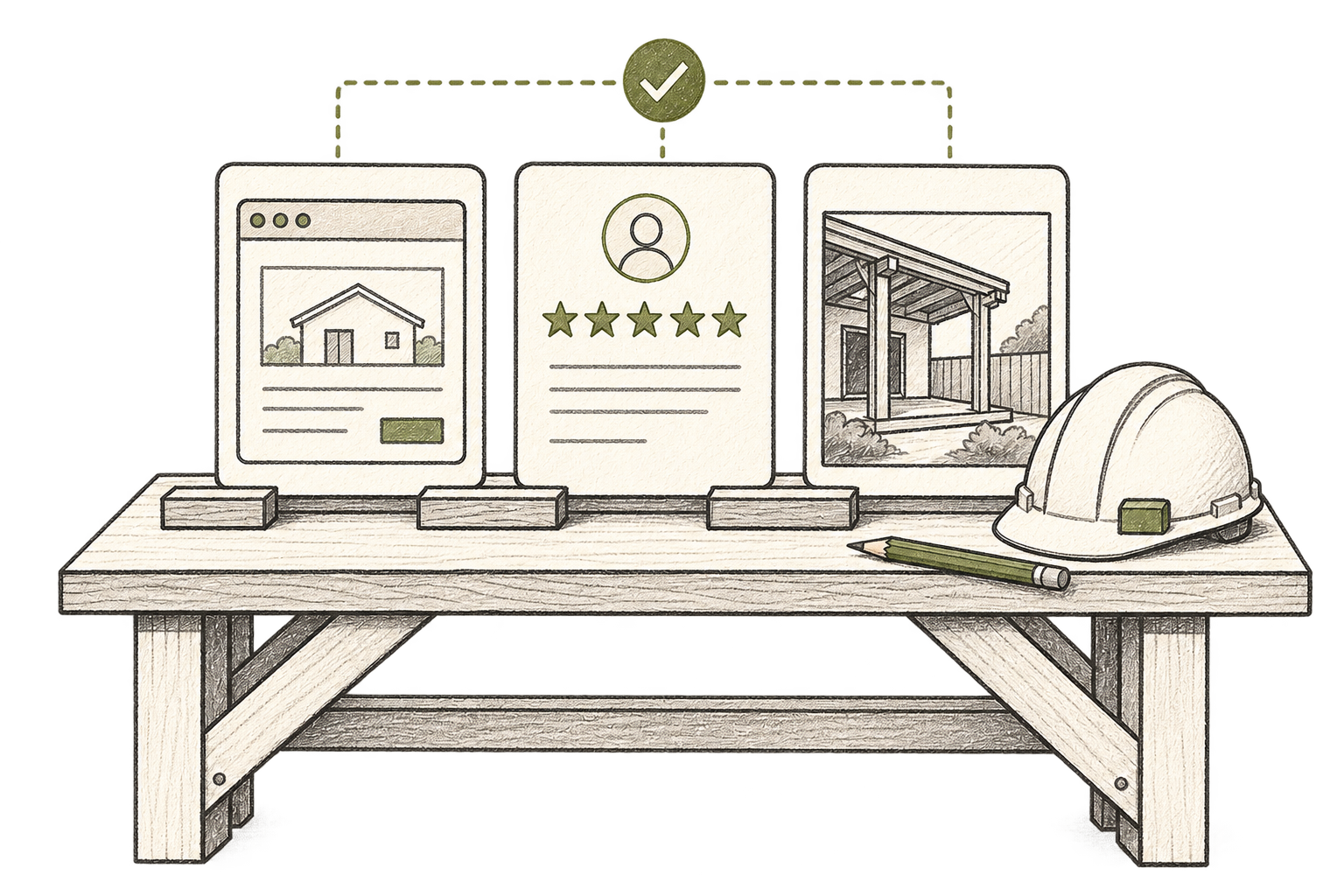
Your website can explain the business. Your Google profile can establish local relevance. Reviews can provide independent reassurance. Photographs can make the quality of the work visible. Social profiles can show that the business is active now. Accreditations, directories and mentions elsewhere can support what you claim.
Each touchpoint answers a different question. Are they local? Do they do this kind of work? Are they any good? Can I trust them? Are they still trading? Would I feel comfortable inviting them into my home or trusting them with a substantial project?
Customers rarely announce that they are asking these questions. They simply collect signals until they feel confident enough to enquire, or uncertain enough to keep scrolling.
Trust compounds across platforms.
Imagine John. He has run a successful building company for twenty years. He does excellent work, his customers recommend him, and he has deep experience, a reliable team and a strong local reputation. Most of his enquiries have always come through word of mouth.
One of John’s previous customers recommends him to a friend planning a major renovation. John has not advertised. He has been recommended.
But the friend still checks.
They find a clear website showing the sort of projects John wants more of. His Google details are accurate. Recent reviews repeatedly mention reliability, communication and quality. His photographs show genuine finished work. His social profile confirms the company is active. His accreditations are easy to verify.
None of those things created John’s reputation. Together, they made it believable to someone who had never met him.
Now imagine the opposite. The website is broken. The last review is three years old. Facebook lists a different phone number. The photographs are poor. One directory describes him as a general handyman while another lists areas he no longer covers.
The recommendation has not disappeared, but doubt has entered the decision.
This is the part many businesses underestimate. A strong presence is not one perfect website or one impressive review score. It is the cumulative effect of finding the right evidence in the right places, repeatedly. When the signals agree, trust compounds. When they conflict, confidence leaks.
The good business already exists.
The purpose of a strong digital presence is not to manufacture a more impressive version of a trade business for the internet. The expertise is already there. The reputation has been earned. The workmanship exists. The projects have been delivered and the customers have had good experiences.
But a potential customer does not automatically know what your existing customers know.
They have not seen how carefully you protect a home while work is underway. They do not know that you have solved the same technical problem dozens of times. They do not know why you specify one product over another, how your team communicates or that half of your work comes from previous customers recommending you.
Unless that evidence exists where they are looking, they can only make a decision using what they can see.
The same is increasingly true of the systems helping people discover and compare businesses. Search engines, maps, directories and AI tools need clear information they can find, connect and, where possible, verify. They cannot confidently infer twenty years of expertise from a business name and a mobile number.
Your digital presence should not invent credibility. It should make the credibility you have already earned easier to see, understand and verify.
Being everywhere is not the strategy.
A strong presence across multiple platforms does not mean opening an account everywhere and feeding each one with endless content. That is activity, not strategy.
The aim is to be present in the places that matter to your customers, your trade, your location and the work you want to win. For one business, the critical combination might be a clear website, an excellent Google profile, recent reviews and a strong portfolio of completed projects. For another, it may also include Instagram, Houzz, Checkatrade, an industry directory, manufacturer accreditation or detailed case studies.
The mix will differ, but the principle will not. Wherever the business appears, people should be able to understand who you are, what you do, where you work, what you are particularly good at, what kind of work you want more of and why customers trust you. Most importantly, they should be able to see evidence that supports those claims.
This does not mean using identical wording everywhere. Different platforms have different jobs. Consistency is not sameness. It is agreement. The details agree. The positioning agrees. The quality agrees. The evidence supports the promise. One platform strengthens the next instead of asking the customer to reconcile a different version of the business each time.
That is what turns a collection of profiles into a presence.
Marketing cannot rescue a weak foundation.
You can pay to send more people to a website. You can advertise on Google, boost posts, invest in SEO, hire someone to manage social media or run lead generation campaigns. But what happens when the person you paid to attract begins checking the business?
If the website undersells the work, the Google profile is incomplete, the reviews are old, the photographs are unconvincing and the information changes from one platform to another, more attention does not solve the problem. It exposes it to more people.
Marketing amplifies whatever is already there. It can amplify clarity, credibility and proof, but it can also amplify confusion. That is why the sequence matters. First, build the foundation that helps the right customer understand and trust the business. Then decide whether more attention would be useful.
Some businesses will need paid marketing to create demand, enter a new area or win more of a particular kind of work. Others may discover that the demand already exists. Their real problem is that the business they have built is not being represented clearly enough when people check it.
Those are different problems, and they should not be sold the same solution. A specialist contractor covering the country does not need the same presence as a domestic plumber working within ten miles of home. A company with hundreds of reviews and a poor website does not have the same problem as one with a beautiful website and almost no independent proof.
The right approach depends on the trade, location, customer, competition, reputation and kind of work the business wants to win. One company may need greater visibility. Another may already be visible but lack proof. Another may have excellent evidence scattered across platforms that do not connect. The strategy should fit the business. The business should not be squeezed into somebody else’s package.
That does not mean the owner has to become an SEO specialist, content creator or expert in the latest algorithm. It means the business needs to understand where its customers look, what they need to see and which parts of the current presence are quietly creating doubt. Only then can it make sensible decisions about websites, photography, advertising, SEO or content.
Build the presence before you buy the attention.
Good trade businesses have always built their reputations through workmanship, reliability, experience, relationships, repeat customers and recommendations. Digital presence has not replaced any of that. It has become the network of places where that reputation is discovered, checked and understood.
The advantage does not come from one platform in isolation. It comes from the right platforms working together, each adding context, evidence and reassurance to the next.
So instead of asking, “What digital marketing should we be doing?” ask something more useful: “When the right customer checks our business, does everything they find make us easier to understand, trust and choose?”
If the answer is no, buying more attention may not be the next move. Building a stronger presence is.
Marketing can win attention. Your digital presence has to win the decision.