The Four-Second Test
Ask a builder what they do and the answer comes instantly.
Ask a plumber what type of work they specialise in and they can tell you in seconds.
Ask an electrician what jobs they enjoy most and where their expertise lies and they don't need to think about it.
A few months ago I started doing something slightly odd.
I began looking at trade businesses online and timing how long it took me to understand them. Not whether they looked professional, had good reviews or ranked well. Just whether I understood them.
Some passed almost instantly.
Others left me guessing.
And the surprising thing was that quality had very little to do with it.
Some of the businesses that impressed me most were actually the hardest to understand. The workmanship was excellent. The reviews were excellent. The reputation was excellent. Yet after several minutes I still found myself asking simple questions.
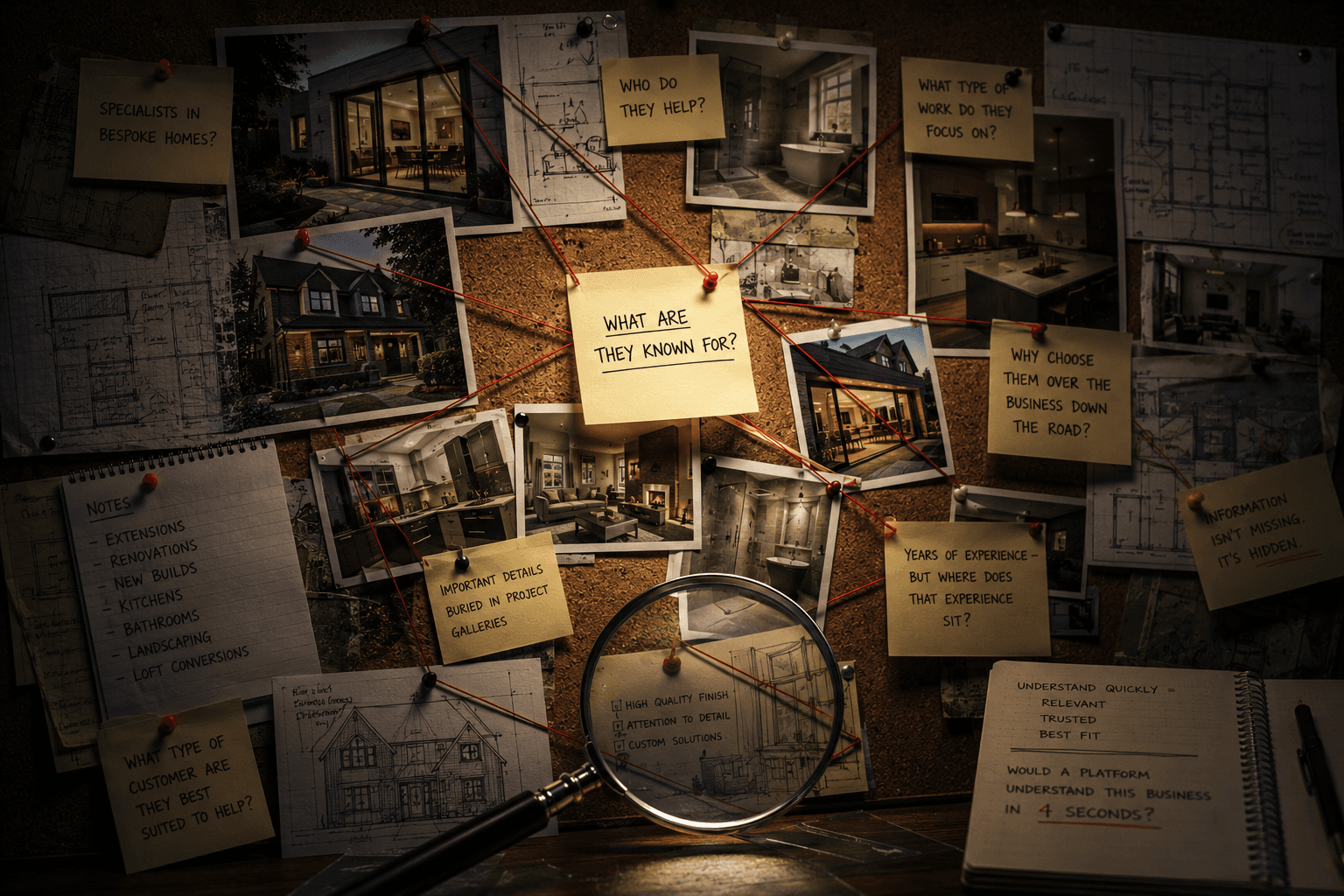
What are they actually known for?
What type of customer are they best suited to help?
What kind of work do they enjoy most?
Why would somebody choose them over the business down the road?
The answers probably existed. The problem was that I couldn't find them. Or more accurately, I couldn't find them quickly.
The exercise started as a way of testing a theory.
The more I studied how AI platforms and modern discovery tools work, the more one question kept coming back to me.
If a platform had to understand a business quickly, could it?
Not whether it could find the business. Whether it could understand it.
Those are very different things.
Once I started looking through that lens, I began noticing the same pattern everywhere. Some businesses were immediately clear. Within seconds, you understood what they did, who they helped and what type of work they were known for.
Others required detective work. Information was scattered across different platforms. Important details were buried inside project galleries. Specialisms were implied rather than explained. Years of experience existed, but there was little indication of where that experience actually sat.
The information wasn't missing. It was hidden.
That might not have mattered much when customers were doing all the hard work themselves. Today, however, platforms are increasingly helping people compare, assess and choose businesses.
Which raises an interesting question.
If platforms are increasingly helping people make decisions, how much time will they spend trying to understand yours?
Probably far less than a customer would.
A platform doesn't browse your website with a cup of tea and twenty spare minutes.
It looks for signals. Patterns. Evidence.
It tries to build an understanding of who you are, what you do and whether you appear relevant to the task in front of it. That process happens remarkably quickly.
If a platform examined your business today, would it quickly understand what you are known for?
Would it understand where your expertise lies?
Would it understand the type of projects you are best suited to undertake?
Or would it still be trying to work it out?
That question feels increasingly important.
Because the next phase of discovery will not belong solely to the businesses that rank number one.
It will increasingly favour the businesses that can pass the Four-Second Test.